
This post is also available in:
 Deutsch

Many companies invest time, money, and energy into digital marketing, but still don’t get the results they expected. They post on social media, run ads, update their website, try SEO, test new tools, and follow what other companies are doing. But instead of clear growth, they often create more noise.
The problem is not always the effort. The problem is usually the lack of alignment. A company can be very active online and still move in the wrong direction. It can publish content every week, spend money on ads, and use the latest tools, but if the message is unclear, the website is weak, the offer is not connected, and the audience is not properly understood, the result will stay random.
Digital growth does not happen because a company does more. It happens when the right things work together. Positioning, message, website, content, SEO, channels, timing, budget, and team all need to point in the same direction. That is the idea behind the 90-Day Resonance Strategy.
It is not about doing everything, copying trends, or posting more. It is about turning scattered digital activity into one focused growth system. At MyBusiness.Team, we see strategy as a system, not as luck, guessing, or random action. A business grows more predictably when strategy, content, and execution work together. That is where resonance begins.
“In the quantum world, it doesn’t take more force to move an electron – only the right frequency. Business works the same way.”
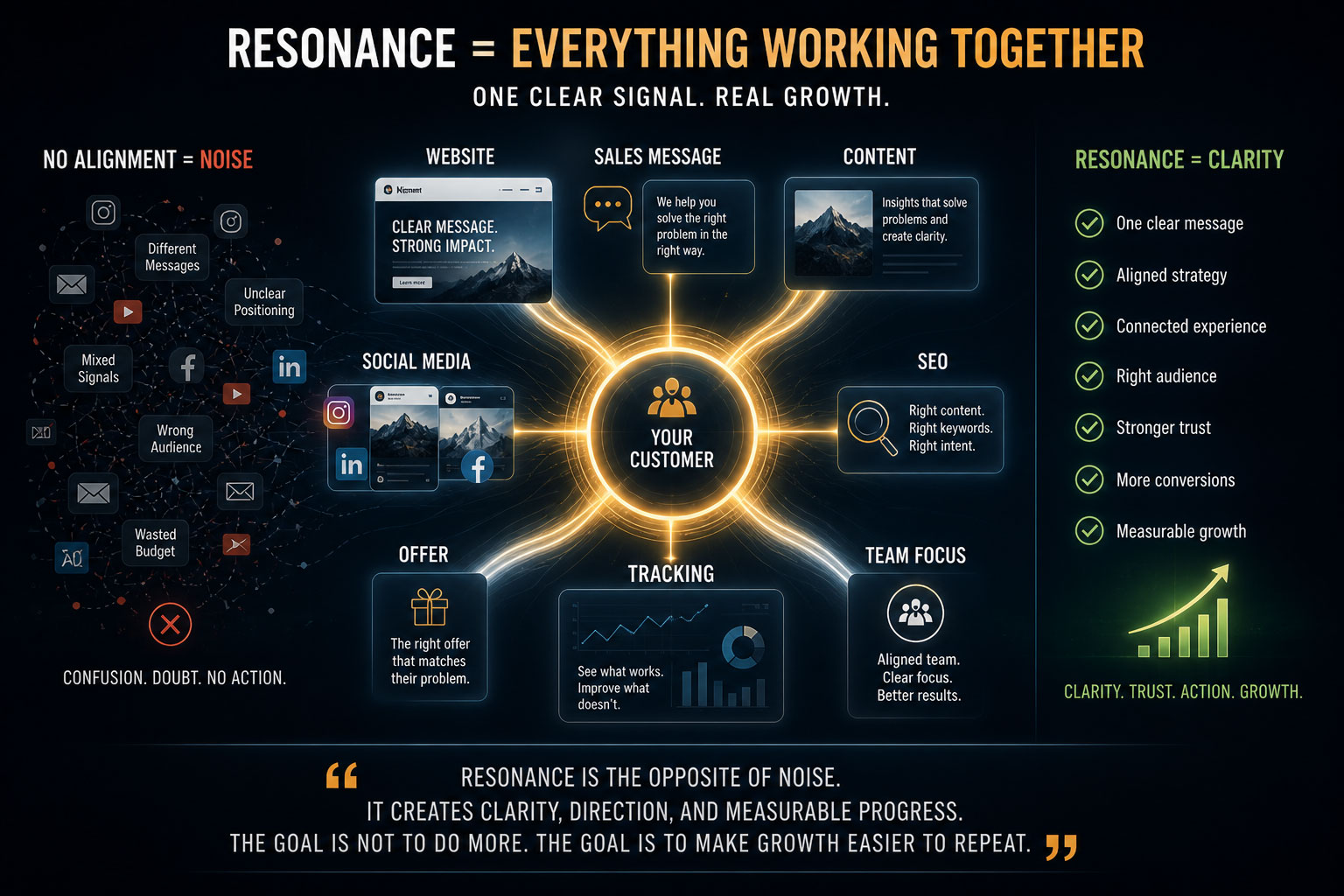
Resonance may sound abstract, but in business it means something very practical: all important parts of your digital marketing support each other. Your website, sales message, content, SEO, offer, social media, tracking, and team focus should not work as separate pieces. They should work together and send one clear signal.
When this happens, people understand who you are, what you offer, why it matters, and what they should do next. Your content answers the questions your customers already have. Your SEO brings in people with the right intent. Your offer matches their problem. Your website guides them toward the next step. Your tracking shows what works and what wastes energy.
When these parts are not aligned, the market receives mixed signals. One message appears on the website, another in social posts, the ads push a different promise, and the offer page does not match the original interest. Even if every single part looks good on its own, the full system still feels unclear.
Resonance is the opposite of noise. It creates clarity, direction, and measurable progress. The goal is not to force growth by doing more. The goal is to create the conditions where growth becomes easier to repeat. When your energy is focused, your strategy is clear, and your timing fits the market, your business moves forward with less waste.
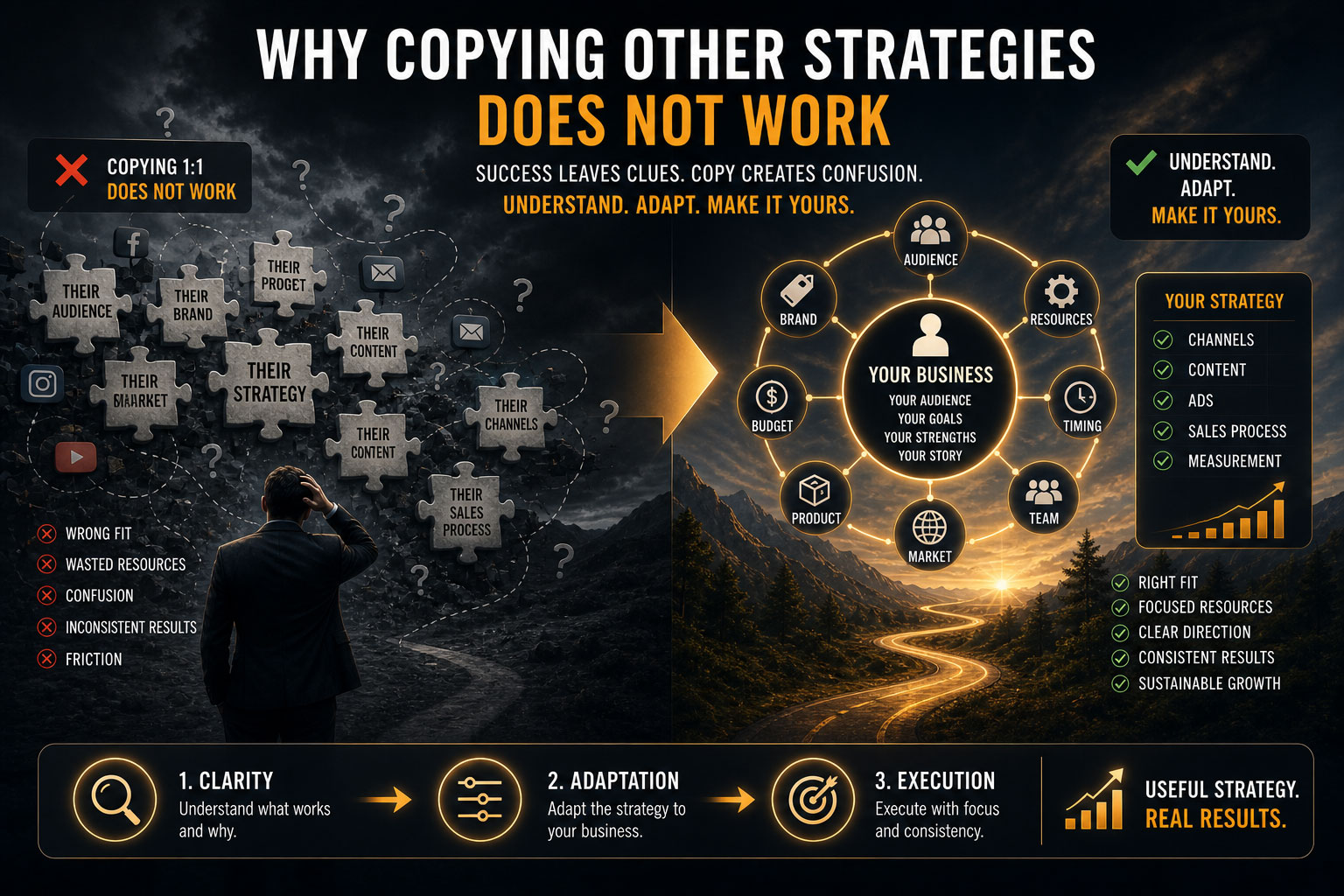
It is natural to look at successful companies and ask what they are doing differently. Which channels do they use? How do they write? How do they sell? What does their website look like? What kind of content do they publish? Studying this can be useful, because successful companies often leave clues in their structure, message, offers, content, SEO, advertising, and sales process.
But you cannot copy their strategy 1:1. Their strategy works because it fits their conditions. It fits their audience, brand, timing, budget, team, product, and market position. Your business is different. Your company has a different story, different strengths, different customers, different challenges, different resources, and different goals.
That means the goal is not to copy. The goal is to understand. You need to understand why something works, then adapt it to your own business. A strategy that works for a large brand with a huge budget may not work for a smaller company. A strategy that works in one country may not work in another. A strategy that works for a low-price product may not work for a premium service.
Copying without understanding creates friction. Understanding creates direction. First comes clarity, then adaptation, then execution. That is how a useful strategy is built.
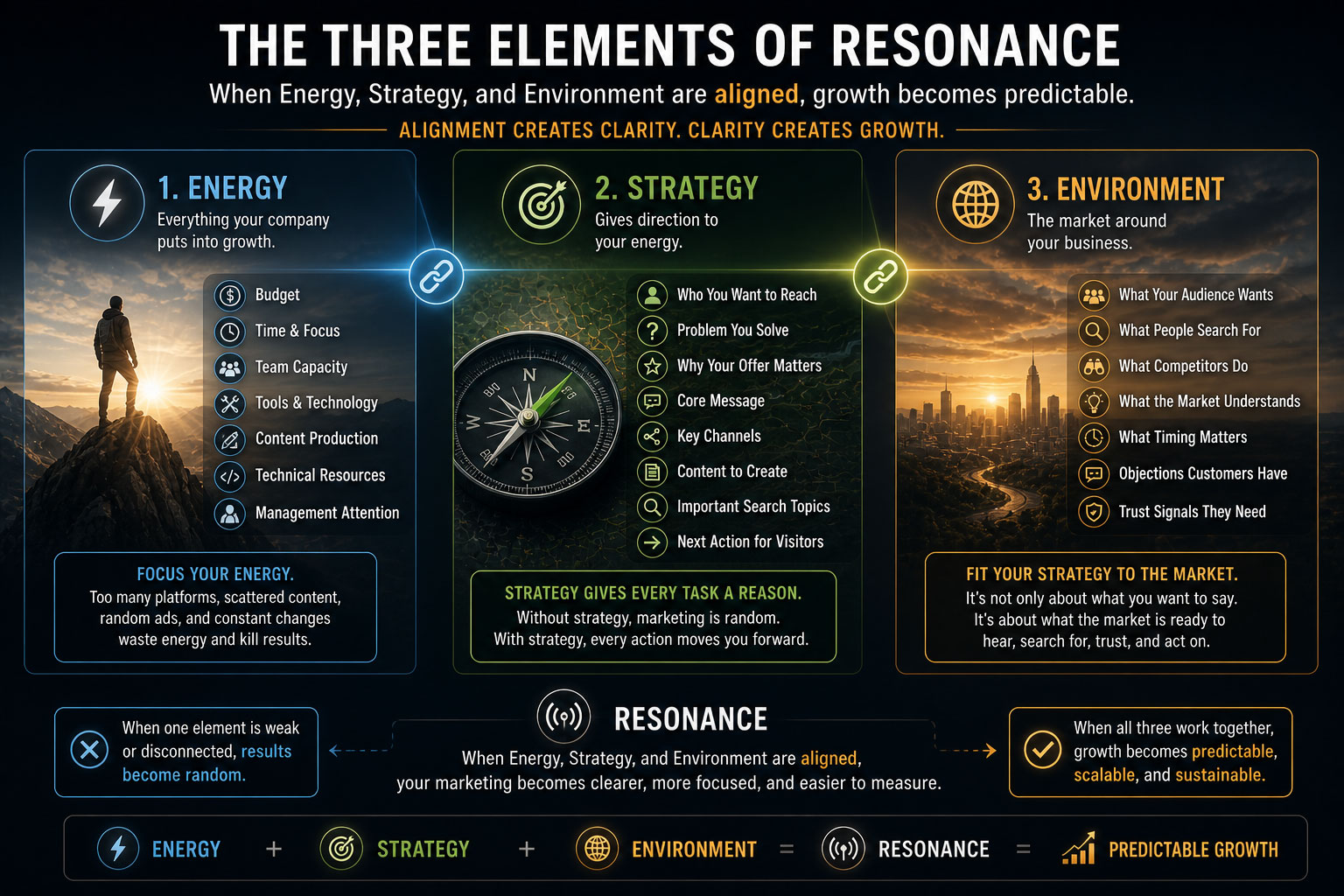
The 90-Day Resonance Strategy is built around three elements: energy, strategy, and environment. When these three areas are aligned, digital marketing becomes clearer, more focused, and easier to measure. When one of them is weak or disconnected, results become random.
Energy is everything your company puts into growth. This includes budget, time, focus, team capacity, tools, technical resources, content production, and management attention. Many companies waste energy because they spread it too thin. They try too many platforms at the same time, create content without a clear purpose, run ads without proper landing pages, buy tools without a system, and change direction before they have enough data. Energy only creates growth when it is focused.
Strategy gives direction to your energy. It defines who you want to reach, what problem you solve, why your offer matters, which message should be repeated, which channels matter most, which content needs to be created, which search topics are important, and which action the visitor should take next. Without strategy, marketing becomes a collection of random tasks. With strategy, every task has a reason.
Environment means the market around your business. It includes what your audience wants, what people are searching for, what competitors are doing, what the market already understands, what timing matters, what objections customers have, and what trust signals they need before they act. A strong strategy still needs to fit the environment. Growth happens when your internal system fits the external market. That is why resonance is not only about what you want to say. It is also about what the market is ready to hear, search for, trust, and act on.
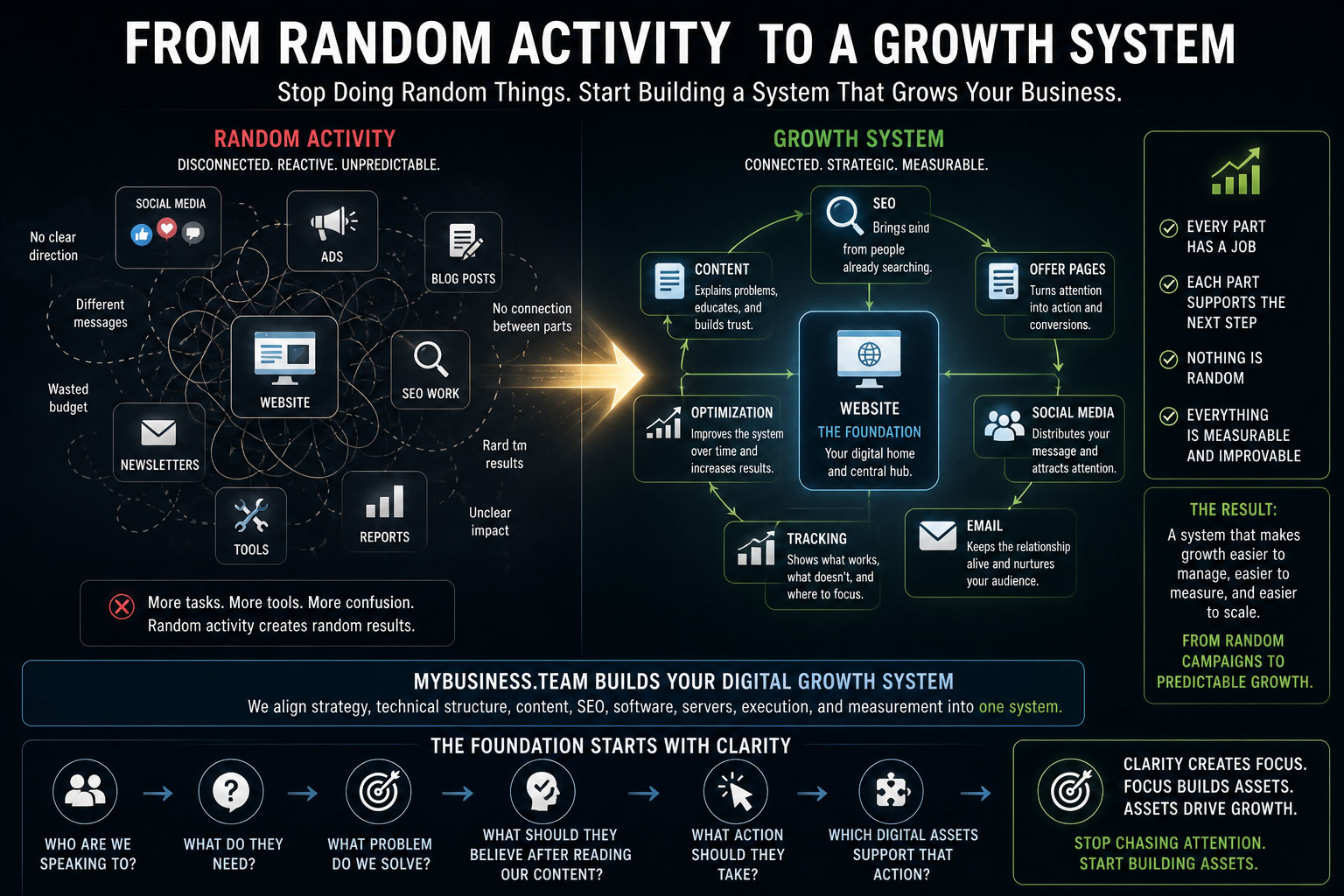
Many companies don’t have a digital growth system. They have digital activity. There is a website, social media, maybe ads, maybe blog posts, maybe newsletters, maybe SEO work, and often a collection of tools and reports. But the parts are not always connected.
A growth system connects them. The website becomes the foundation. SEO brings in demand from people already searching. Content explains problems and builds trust. Offer pages turn attention into action. Social media distributes the message. Email keeps the relationship alive. Tracking shows what works. Optimization improves the system over time.
Each part has a job, and each part supports the next step. Nothing is random. This is where MyBusiness.Team comes in. MyBusiness.Team helps companies align strategy, technical structure, content, SEO, software, servers, execution, and measurement into one digital marketing system.
The goal is not to give companies more tasks. The goal is to build a system that makes digital growth easier to manage, easier to measure, and easier to scale. A strong business should not depend on random campaigns. It should have a digital foundation that works every day.
That foundation starts with clarity. Who are we speaking to? What do they need? What problem do we solve? What should they believe after reading our content? What action should they take? Which digital assets support that action? Once these questions are answered, marketing becomes more focused. The business stops chasing attention and starts building assets.
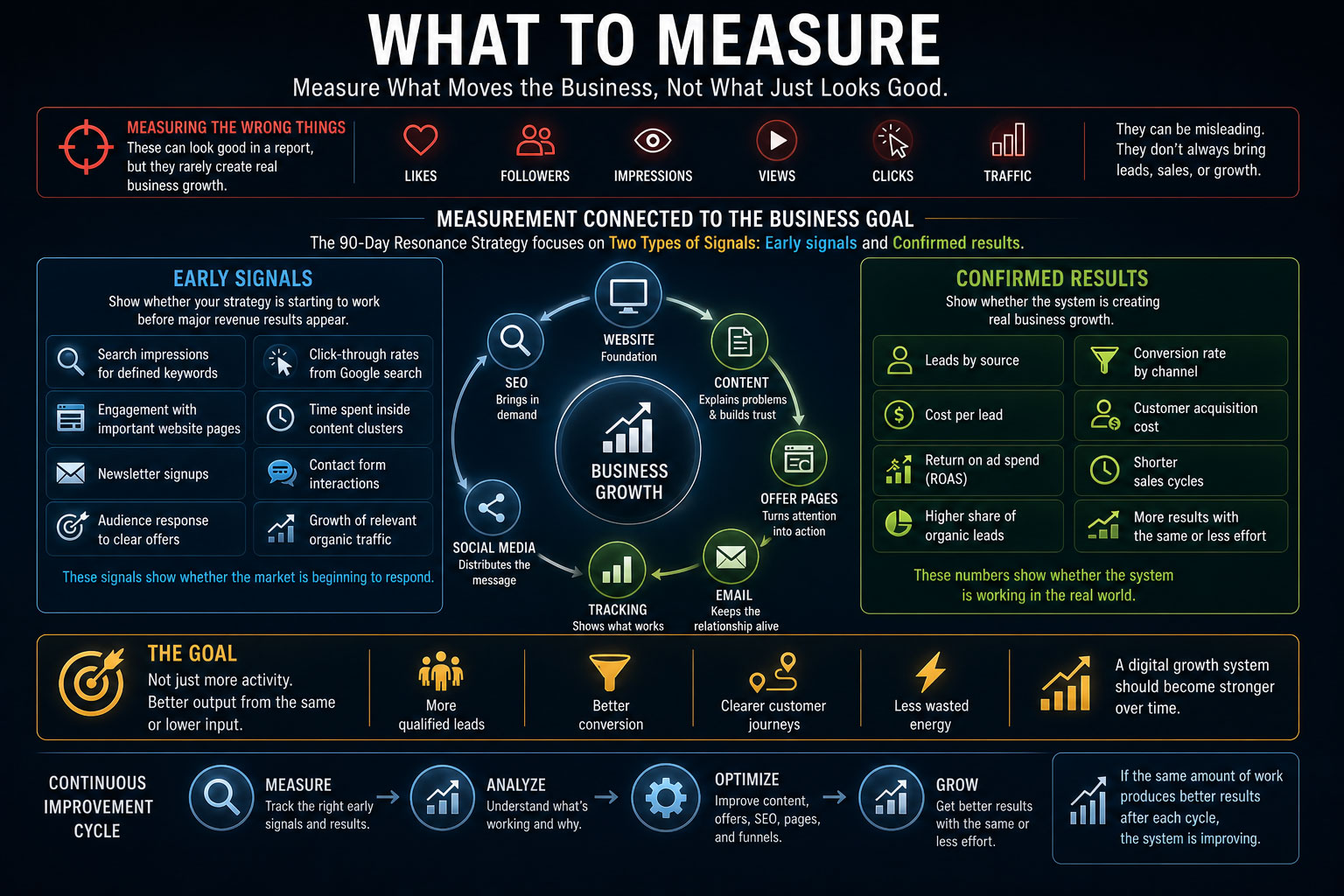
Many companies measure the wrong things. Likes, followers, impressions, and views can be useful, but they don’t always show real business growth. They can make a report look good while the business itself does not move forward. A post can get many likes and produce no qualified leads. A website can get traffic and still fail to convert. An ad can receive clicks and still attract the wrong audience.
That is why measurement needs to be connected to the business goal. The 90-Day Resonance Strategy looks at two types of signals: early signals and confirmed results. Early signals show whether your strategy is starting to work before major revenue results appear. Confirmed results show whether the system is creating real business growth.
Early signals include search impressions for defined keywords, click-through rates from Google search, engagement with important website pages, time spent inside content clusters, newsletter signups, contact form interactions, audience response to clear offers, and growth of relevant organic traffic. These signals show whether the market is beginning to respond.
Confirmed results include leads by source, conversion rate by channel, cost per lead, customer acquisition cost, return on ad spend, shorter sales cycles, a higher share of organic leads, more qualified inquiries, and more results with the same or less effort. These numbers show whether the system is working in the real world.
The goal is not just more activity. The goal is better output from the same or lower input. That means more qualified leads, better conversion, clearer customer journeys, and less wasted energy. A digital growth system should become stronger over time. If the same amount of work produces better results after each cycle, the system is improving.
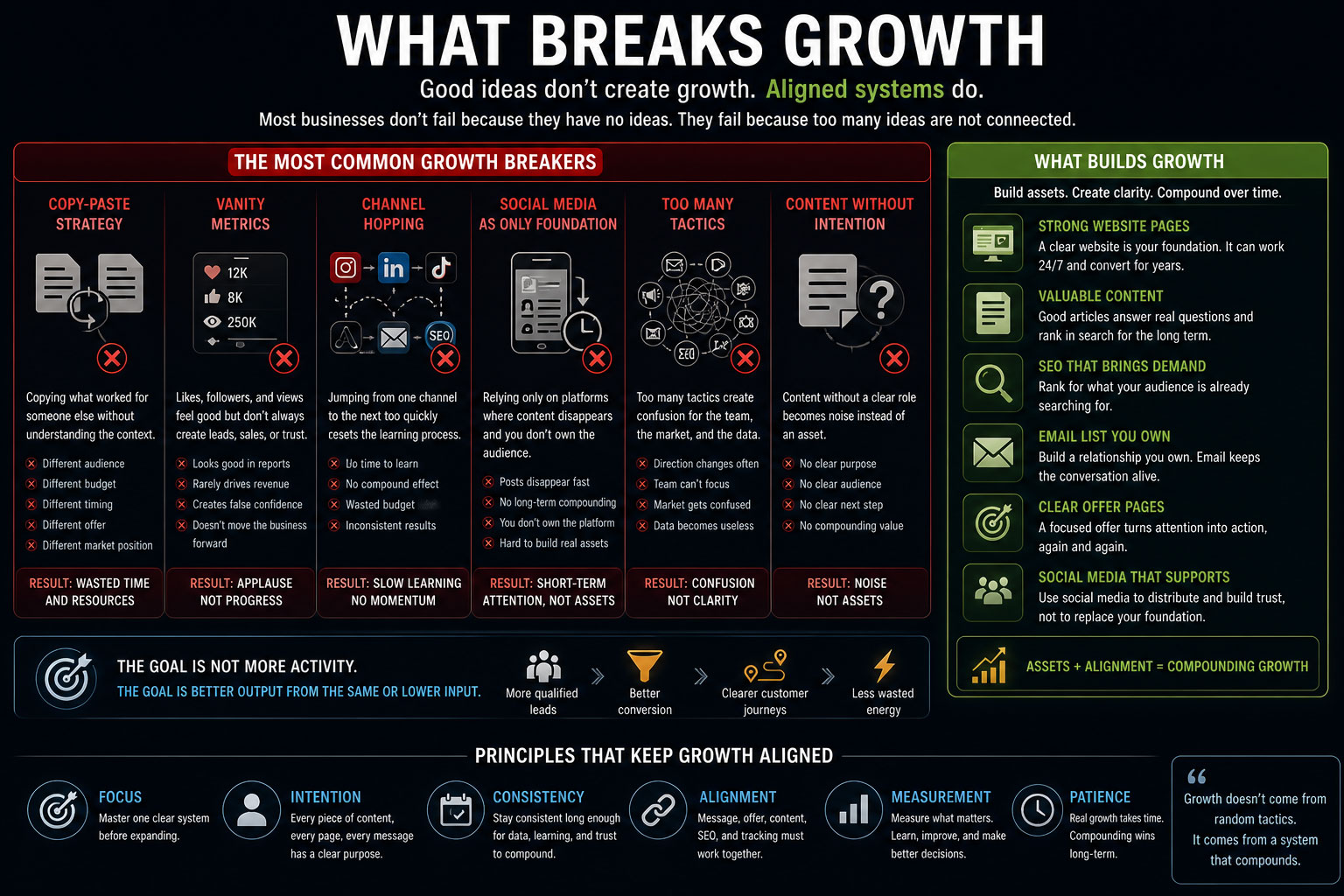
Most businesses don’t fail because they have no ideas. They fail because too many ideas are not connected. A company can have good people, good products, good content, and good intentions, but still lose momentum if the system is misaligned.
One common problem is copy-paste strategy. A company sees what worked for someone else and tries to copy it, but the context is different. The audience, budget, timing, offer, brand, and market position are not the same. What worked there may not work here. The better question is not, “Can we copy this?” The better question is, “What principle is behind this, and how can we make it fit our business?”
Another problem is vanity metrics. Likes, followers, and views can feel good, but they don’t always create leads, sales, or trust. Visibility is only useful when it moves the business forward. The goal is not applause. The goal is progress.
Growth also breaks when companies jump from one channel to the next too quickly. One month they focus on Instagram, then LinkedIn, then TikTok, then paid ads, then SEO, then a newsletter. Every switch resets the learning process. Better growth comes from mastering one clear system first, then expanding with intention.
Social media can be powerful, but it should not be the only foundation. A post disappears quickly. A strong website page can work for years. A good article can rank in search. An email list can be owned. A clear offer page can convert again and again. Social media should support the system, not replace it.
Too many tactics create confusion. If a company changes direction every two weeks, the team cannot learn, the market cannot understand the message, and the data becomes useless. The same applies to content without intention. Every article, page, email, and post should have a clear role. Content without intention becomes noise. Content with intention becomes an asset.
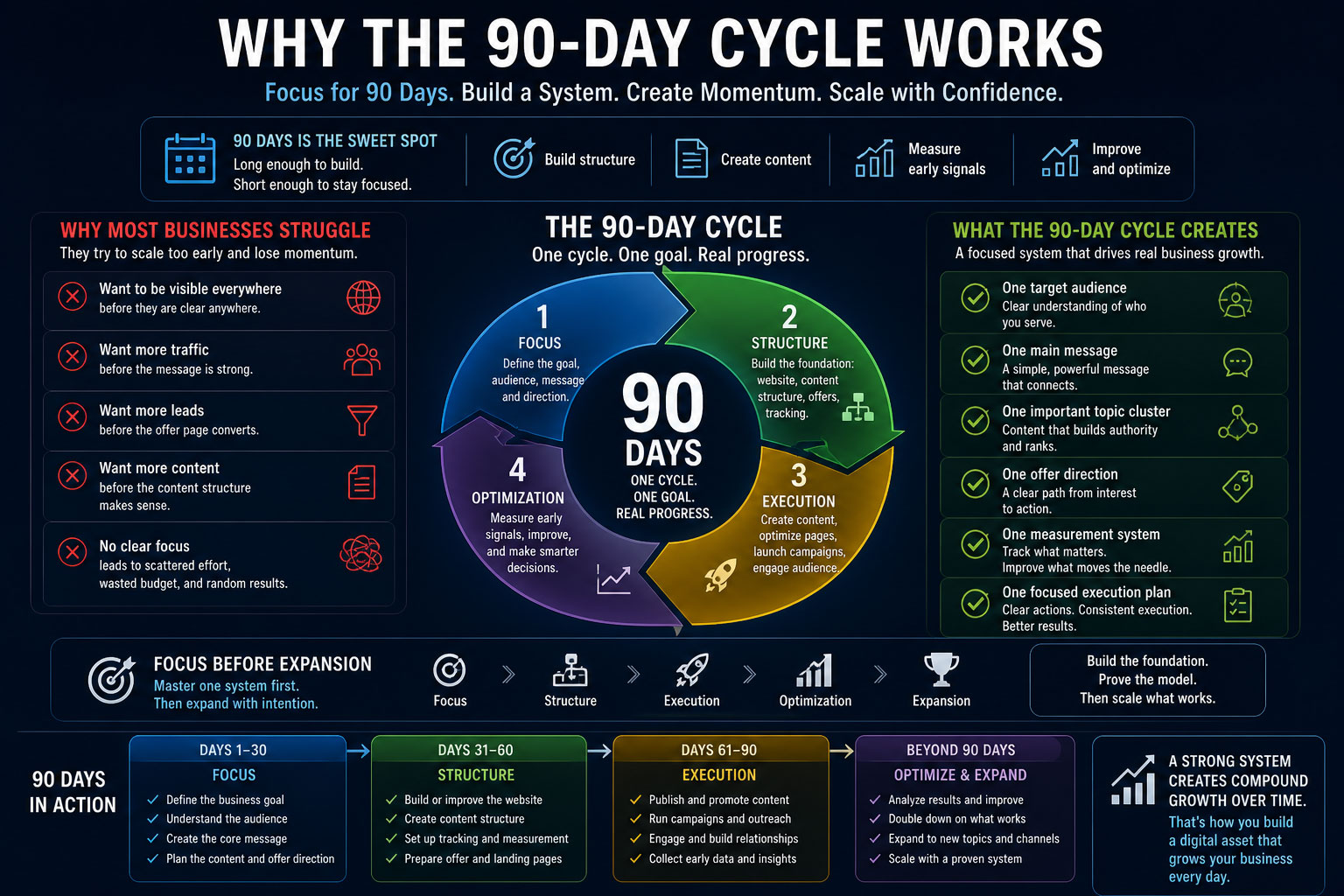
A business does not need endless planning. It needs a clear cycle. Ninety days is long enough to build structure, create content, measure early signals, and make improvements. It is also short enough to stay focused.
The purpose is not to fix everything at once. The purpose is to build one focused digital growth system around one clear business goal. That means one target audience, one main message, one important topic cluster, one offer direction, one measurement system, and one focused execution plan.
This is important because many companies try to scale too early. They want to be visible everywhere before they are clear anywhere. They want more traffic before the message is strong. They want more leads before the offer page converts. They want more content before the content structure makes sense.
The 90-day cycle avoids that mistake. It creates focus first, then structure, then execution, then optimization. Only after that comes expansion. Focus before expansion. That is the core principle.
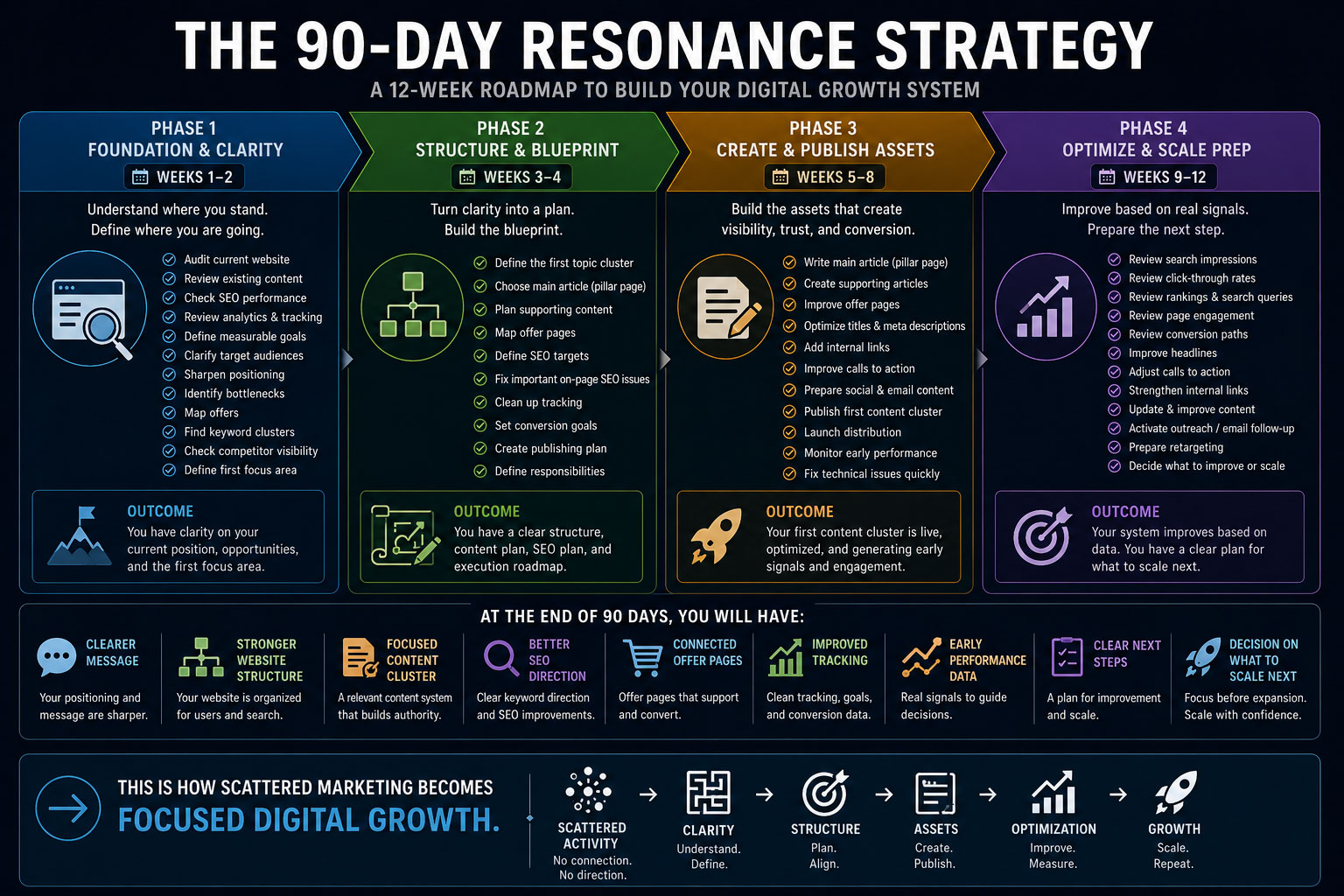
The 90-Day Resonance Strategy is divided into four phases. Each phase has a clear purpose. Weeks 1 and 2 create clarity. Weeks 3 and 4 create structure. Weeks 5 to 8 create assets. Weeks 9 to 12 improve the system and prepare the next step.
In the first two weeks, the focus is foundation. Before creating new content or launching new campaigns, the company needs to understand where it stands. This includes auditing the current website, reviewing existing content, checking SEO performance, reviewing analytics and tracking, defining measurable business goals, clarifying target audiences, sharpening positioning, identifying bottlenecks, mapping offers, finding keyword clusters, checking competitor visibility, and defining the first focus area.
Weeks 3 and 4 turn clarity into structure. This is where the digital growth system gets its blueprint. The company defines the first topic cluster, chooses the main article or pillar page, plans supporting content, maps offer pages, defines SEO targets, fixes important on-page SEO issues, cleans up tracking, sets conversion goals, creates the publishing plan, and defines who is responsible for what.
Weeks 5 to 8 are about creation. Now the company builds the assets that create visibility, trust, and conversion. This includes writing the main article or pillar page, creating supporting articles, improving offer pages, optimizing titles and meta descriptions, adding internal links, improving calls to action, preparing social and email content, publishing the first content cluster, launching distribution, monitoring early performance, and fixing technical issues quickly.
Weeks 9 to 12 are about optimization. Instead of guessing, the company improves based on real signals. This includes reviewing search impressions, click-through rates, rankings, search queries, page engagement, and conversion paths. Weak headlines are improved, calls to action are adjusted, internal links are strengthened, content is updated, outreach or email follow-up can be activated, retargeting can be prepared, and the team decides what should be improved or scaled next.
At the end of 90 days, the company should have a working digital growth system. It should have a clearer message, a stronger website structure, a focused content cluster, better SEO direction, connected offer pages, improved tracking, early performance data, clearer next steps, and a decision about what to scale next. This is how scattered marketing becomes focused digital growth.
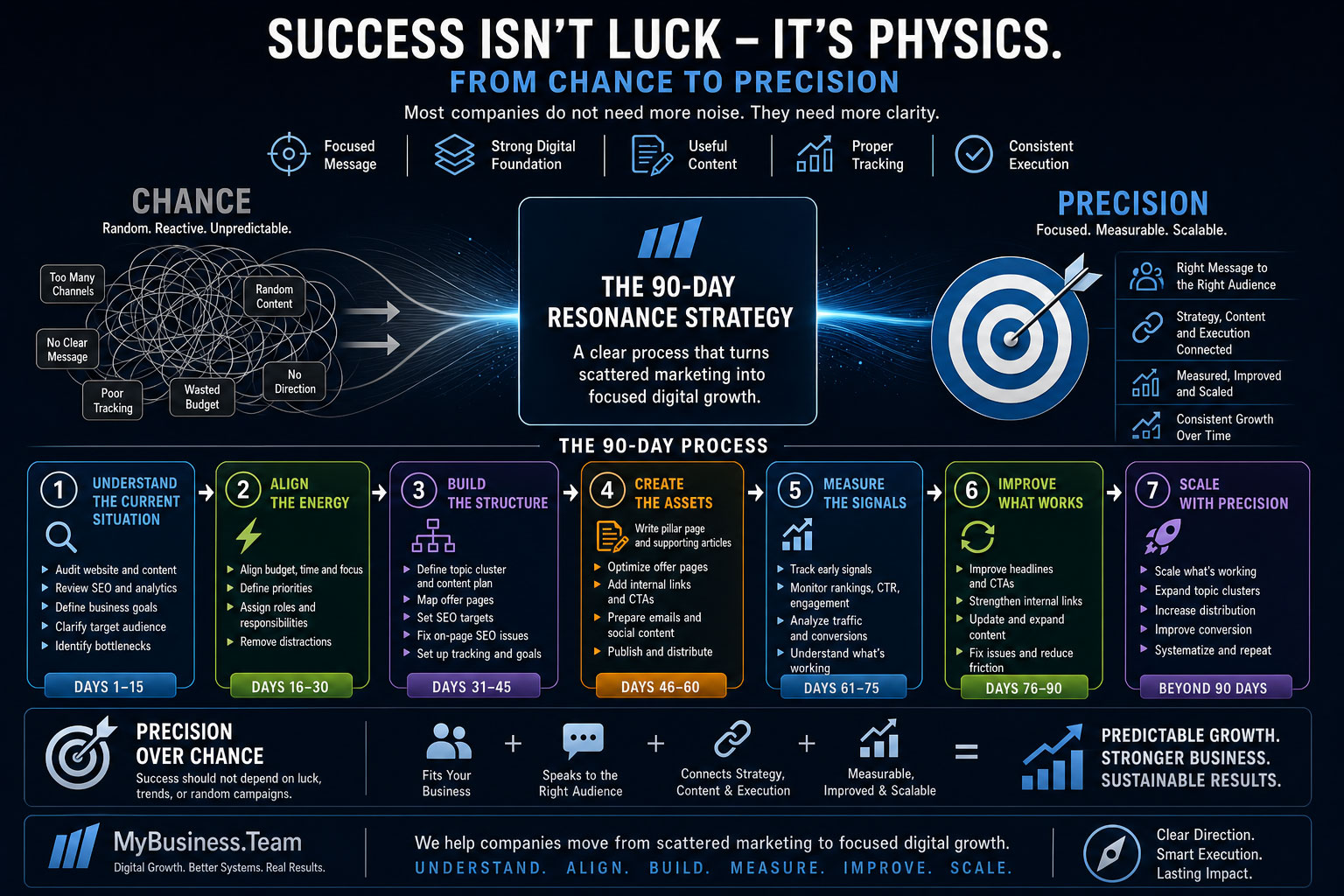
Most companies do not need more noise. They need more clarity. They need a focused message, a strong digital foundation, useful content, proper tracking, and consistent execution. The 90-Day Resonance Strategy helps create that structure.
It gives the business a clear process: understand the current situation, align the energy, build the structure, create the assets, measure the signals, improve what works, and scale with precision. That is how growth becomes less random. That is how strategy becomes practical.
Precision over chance means that success should not depend on luck, trends, or random campaigns. It should come from a system that fits the business, speaks to the right audience, connects strategy, content, and execution, and can be measured, improved, and scaled.
That is the purpose of the 90-Day Resonance Strategy: understand, align, build, measure, improve, and scale. This is how MyBusiness.Team helps companies move from scattered marketing to focused digital growth.
Success in business is not magic. It is not luck. It is not the result of random posts, scattered campaigns, or copying what others do. It becomes predictable when the system behind it is clear.
The 90-Day Resonance Strategy brings scattered digital activity into one focused growth system. It helps companies understand where they stand, align their message, build the right digital assets, measure the right signals, and improve with precision. That is how a business moves from guessing to control.
It moves from noise to clarity, from scattered action to focused growth, and from chance to precision.
Business success isn’t luck – it’s precision.
Build the system that sets your conditions – and the dice will always fall your way.
The Resonance Strategy was developed by Daniel Deeb Badr for companies that want measurable growth. It was created from the real problems companies face every day: unclear positioning, weak digital structures, scattered content, wasted budgets, poor tracking, and marketing activities that are not connected.
The purpose of this strategy is simple: to help companies stop guessing and start building a digital system that works. By aligning strategy, content, execution, tracking, and optimization, MyBusiness.Team helps businesses create a clearer foundation for growth, stronger visibility, better customer journeys, and more measurable results.
This is not about doing more for the sake of doing more. It is about doing the right things in the right order, with a system that can be measured, improved, and scaled.
